Claude Academy, Part 1: An AI Learning Experiment
 If I’m not learning, it’s time to leave. That’s the general ethos I’ve taken to my career. I enjoy learning, and life is too short to just coast by. At home, however, the things I want to learn - coffee roasting, homebrewing, obscure historical literature — these aren’t exactly Coursera staples. There’s no MOOC for the Kojiki. Even when there is, the available resources aren’t flexible enough for hobbies – funneling me down paths I’m not ready for or focusing on areas I don’t care about. A recent EconTalk may have just had a solve.
A few months ago I was listening to an EconTalk episode with Tyler Cowen — “AI, Employment, and Education” — and Tyler made an argument that stuck with me. AI has the potential to enrich not only education, but the self. And he challenged Russ Roberts to run experiments at his university: allow students to create curriculum using AI for subjects his college does not yet offer. That challenge resonated with me. So I built something.
What Claude Academy Is
Claude Academy is a Claude skill — a set of agents and slash commands — that generates complete, personalized courses on any subject you want to learn. You register as a student, enroll in a topic, and work through structured sessions at your own pace. If the course doesn’t exist yet, the system builds it from scratch before your first class.
The interface is simple: /register to create your student profile, /enroll coffee roasting to kick off a course, /study to begin a session. The first three courses I created and enrolled in are home coffee roasting (COFF-100), classical philosophy (PHIL-100), and Japanese literature studying the Kojiki (LITR-100), with a companion lab course for the coffee roasting (COFF-100L) that logs actual roast sessions as structured data.
How a Course Gets Built
When you enroll in a topic that doesn’t have a course yet, two agents go to work. First, the Researcher. It doesn’t just search the web — it evaluates sources against a tiered hierarchy. Tier 1 is official documentation and authoritative organizations. Tier 2 is academic and peer-reviewed. It works down from there, and it must find at least one Tier 1 or 2 source or explicitly flag that it couldn’t.
Once research is complete, the Course Creator builds the curriculum. Every session has one primary concept. Lessons open with a hook: a question, a surprising fact, a scenario. Never a definition. The tutor uses a light Socratic method, checks in during sessions rather than just lecturing, and won’t jump ahead to answer questions about future material. If you ask about Session 6 while you’re on Session 3, you get a redirect and a bridge to what you’ve already covered. Pedagogy is baked into the agent instructions.
The output is a complete course: syllabus, lessons, exercises, quizzes, a midterm, and a capstone final project. All generated from research. All structured.
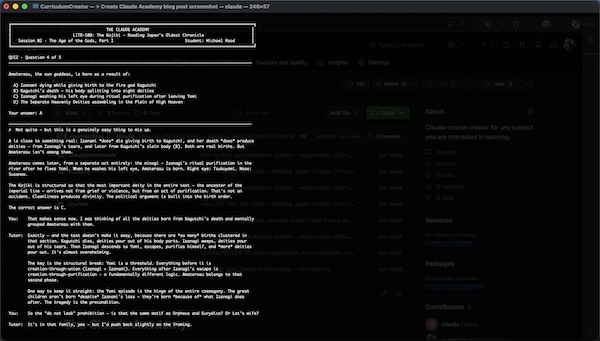
Example course to help me read Kojiki
How It Adapts to You
This is the part I’m most proud of — over time the tutor will be able to personalize the teaching approach to you, your interests, and your knowledge. The tutor continually adds observations to your student profile — comments you made in response to Socratic questioning, bridges that resonated. Then going forward an agent will personalize a course for you after enrollment - pulling scenarios from your existing domains and interests so the practice problems feel grounded rather than abstract. The learning objective doesn’t change. Just the framing.
When I worked through the coffee roasting course, the tutor knew I was a homebrewer. When it came time to explain roast development — the window between first crack and drop where the bean’s flavor profile is determined — it drew a parallel to mash conversion. Same idea: time and temperature interacting to produce a specific outcome. That connection stuck in a way that a generic explanation might not have. And once the Tutor recorded that the bridge worked, it got added to my profile’s analogy palette. Future courses can draw on it.
Three Design Decisions Worth Calling Out
A few things I’m particularly happy with:
Evidence-based profile enrichment. The system never speculates about what you know or how you think. It only updates your profile when there’s direct evidence from a session. This keeps personalization honest — it reflects what you actually demonstrated, not what you filled in on a form.
Flagged curriculum gaps. Every progress file has a flagged_gaps array. When you ask a question the lesson doesn’t adequately answer, the Tutor logs it there. This separates learner failures — things you personally struggled with — from curriculum failures, where the lesson itself came up short. It’s a feedback loop for the course material, not just the student.
Source tier gating. The course itself records its research_quality — “strong,” “practitioner-sourced,” or “mixed.” You know the evidence base behind what you’re being taught before you start. That transparency matters to me. I’d rather know a course is built on strong academic research versus long-running practitioner blogs than have it all look the same.
Why I Think this Concept has Legs
Personalization here is structural, not cosmetic. Claude Academy doesn’t just swap out a name or adjust a difficulty slider — it rewrites every exercise specifically for your background and builds bridges between subjects based on what you already know. The framing changes. The learning objective doesn’t.
What I find more interesting is that the student profile is discovered, not declared. Students don’t know how they learn. Hell, I’ve been doing this for 41 years and I barely know how I learn. Claude Academy documents through observation what analogies land and which ones don’t. My hope is that the Academy can know how I learn better than I do.
Quizzes are learning instruments, not gatekeepers. I’m not interested in stressing about a GPA at 41. If I perform poorly on a quiz, the tutor revisits those subjects in subsequent lessons. The goal is to learn, not to score.
What’s Next
It is early days, but the coffee roasting course I’m finding genuinely useful — I’m roasting better coffee and understanding why. To see how the system handles more esoteric topics, I created a literature course for my current read “The Kojiki” (古事記) where Tier 1 sources are harder to find. I’m only a couple lessons in but the coursework is helping me establish my own thoughts on the stories and their meanings.
I’m not sure where this blog post series or the project will go. I might just use it to help me through obscure philosophy reads. On the other hand I might discover this is useful for continuing education. I suppose I’ll be chronicling. In the meantime, the code is on GitHub. If you’ve been thinking about something you want to learn that doesn’t seem to exist as a structured course anywhere — give it a shot.